What a Proper Mini Split Cleaning Looks Like, and Why Once a Year
Most owners never see inside their indoor head, which is exactly why dirt can build up there for years.
October 6, 2026 · 4 min read
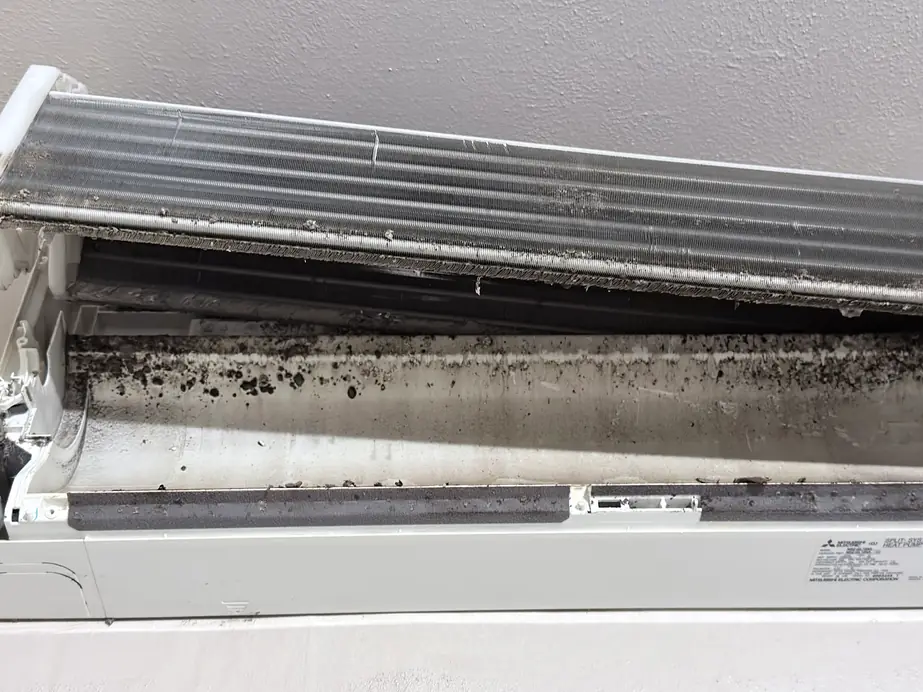
Most people never see the inside of a ductless indoor unit. The front panel looks clean, the filter looks fine, and the system keeps running, so servicing it never crosses anyone's mind. Then one day the air smells stale, water drips from the wrong place, or the head gets noisy, and a technician pops the cover off to find a coil and blower wheel caked in dust. It is common, and a yearly cleaning prevents most of it.
What is actually inside the indoor head
An indoor head has a few parts that matter for cleaning. Air gets pulled in through the filter, passes over a coil that runs cold in cooling mode and hot in heating mode, and is pushed back into the room by a blower wheel, a long drum with many small fins. Below the coil sits a drain pan that catches the moisture the coil pulls out of the air in cooling mode. The filter stops the larger particles. Fine dust, pet hair, cooking residue and pollen get past it and settle on the coil and the blower wheel, where moisture helps them stick.
As that layer thickens, airflow drops and the unit works harder to deliver the same comfort. Damp surfaces can start to smell. A heavily soiled blower wheel can also make the head louder, because the wheel is moving less air than it should and may be out of balance.
The steps of a thorough cleaning
Wiping what you can reach from the front is not a full service. A proper job takes the indoor unit apart with care so every component is cleaned, not just brushed over. In general it looks like this:
- Power the unit off and protect the room. A drop cloth goes under the head to catch debris and water, and nearby furniture or bedding gets covered.
- Remove the front panel and filters, and wash the filters.
- Clean the coil with a coil-safe cleaner and rinse it, keeping water away from the electronics and directing it to the drain pan.
- Remove and clean the blower wheel, because it is the part that hides the most buildup.
- Clean the drain pan and check that the condensate drain is flowing freely.
- Check the condensate pump if the unit has one.
- Reassemble, restart the system in both heating and cooling, and listen for new noises or vibration.
- Clean up. Debris, the drop cloth and any water leave with the technician.
Why the drain and condensate pump get their own attention
In cooling mode, a mini split removes moisture from your indoor air, and that water has to go somewhere. In many installations it drains by gravity through a small line. Where the indoor unit sits too high or too far from a good drain path, a small condensate pump lifts the water away instead.
A pump can clog with debris, wear out or start to buzz, and the first sign is often a drip, a gurgle or a head that shuts itself off. Replacing a worn pump is a routine repair. It is far less stressful when it is caught during a service visit than when water is running down a wall in a rental or an office. If you have more than one head, remember that the upper units and the ones in rooms you rarely enter are the ones nobody checks.
Why once a year
A yearly cleaning is the interval to aim for in most homes and small offices. It is frequent enough that buildup never gets thick, and it lines up with a simple habit: pick a month and keep it. Homes with pets, heavy cooking, a wood stove, or dusty roads and fields nearby collect dirt faster and may deserve more frequent visits. Rentals with changing tenants are another case, since nobody in particular owns the filter.
Spring or early fall, before the busiest heating or cooling stretch, is a sensible time. A clean unit also gives the technician a clear look at the rest of the system, including the line connections, the outdoor unit and the electrical connections, so small problems are found before a heat wave or a cold snap makes them urgent.
What you can do between visits
- Check and rinse the filters on a regular schedule, and more often in heavy heating or cooling seasons. Let them dry fully before putting them back.
- Keep the area around the indoor unit clear so air can flow freely into and out of it.
- Keep the outdoor unit free of leaves, weeds, drifted snow and stored items.
- Pay attention to changes: a new smell, a new noise, drips, weaker airflow or ice on the unit.
- Leave the coil and blower wheel to a technician. The fins bend easily and wiring sits close by.
Who handles this in Selah and Yakima
509 Mechanical Services is the service department of 509 Ductless. It covers diagnostics, routine maintenance, leak detection and repair, and fireplace servicing. A maintenance visit is also a good time to ask about anything that has been bothering you, such as an odd sound, a head that is slow to start, or an upstairs unit that has never been looked at.
If your mini split has not been cleaned in a year or more, or you are not sure when it last was, give us a call at (509) 698-2470. You can also visit the Selah showroom at 311 S 1st St, open Monday through Friday from 9am to 5pm and closed from 12 to 1 for lunch.
509 Ductless, (509) 698-2470
Call (509) 698-2470More articles
Ductless or Central Air? How to Decide for a Yakima Valley Home
The right system depends less on the brand and more on what is already inside your walls and how you live in each room.
How Ductless Zoning Works, and How to Plan It Room by Room
The planning that matters happens at your floor plan, long before anyone picks a model.